
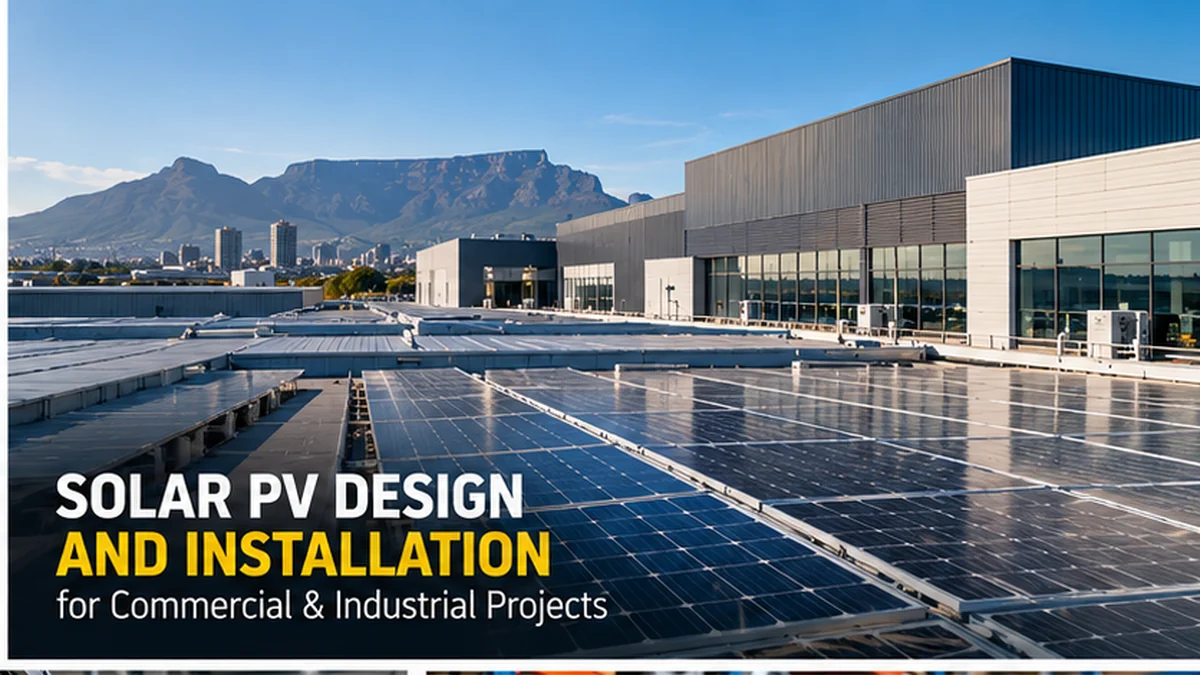
Commercial and industrial solar PV design and installation requires more than placing panels on a roof. Successful projects connect energy analysis, structural assessment, electrical design, safe construction and commissioning into one coordinated plan.
Start with electricity demand and the business case
Review billing history, interval load data, tariff structure, peak demand and operational schedules. The ideal PV capacity is shaped by how much electricity the site uses while the array is producing.
A system that generates surplus power may need export approval, curtailment or storage depending on the site and local network rules.
Assess roofs, ground space and physical constraints
Roof-mounted systems require structural suitability, waterproofing coordination, access paths, fire considerations and appropriate mounting. Ground-mounted arrays need geotechnical and civil review, drainage, security and cable-route planning.
Shading, orientation, dust, wind exposure and access for cleaning and maintenance affect yield and long-term performance.
Electrical design, protection and grid connection
Engineering work covers module strings, inverter selection, DC and AC cabling, isolators, earthing, surge protection, distribution integration and protection coordination. Equipment and installation must satisfy applicable South African standards and utility requirements.
Confirm the relevant municipality or network operator process for registration, approval and any export arrangements before energisation.
Installation, testing and commissioning
A controlled installation sequence includes site safety planning, mounting, cable containment, terminations, labels and quality checks. Commissioning verifies electrical integrity, inverter configuration, protection and monitoring against the approved design.
Handover should include as-built drawings, operating instructions, warranties, test records and a maintenance plan.
Commercial PV versus solar power installation for home
Home installations typically have different load patterns, roof access and commercial objectives. Industrial projects may involve three-phase distribution, demand charges, larger inverter systems and integration with standby power.
Buyers should select a contractor based on demonstrated competence with the relevant project scale and electrical environment, not solely residential installation pricing.
Project and procurement checklist
- 12 months of bills and interval load data
- Roof or ground-space drawings
- Structural and electrical site assessment
- Grid connection and approval requirements
- Performance assumptions and warranty terms
- Commissioning and maintenance deliverables
Questions buyers often ask
How is a commercial solar PV system sized?
Designers evaluate daytime load, tariffs, available installation area, network constraints and expected solar yield before recommending capacity.
Does commercial PV work during load shedding?
Standard grid-tied PV generally shuts down when grid supply fails. Backup operation requires suitable hybrid or island-capable equipment and an engineered design.
What should be included in a solar PV quotation?
Ask for system capacity, equipment schedule, estimated yield assumptions, exclusions, grid approvals, installation scope, warranties and commissioning documentation.
Discuss your requirement with Futuristic 1
For a project-specific discussion, send your scope, drawings, equipment schedule or bill of quantities. Technical selection and commercial proposals should be confirmed against the actual site and project requirements.