
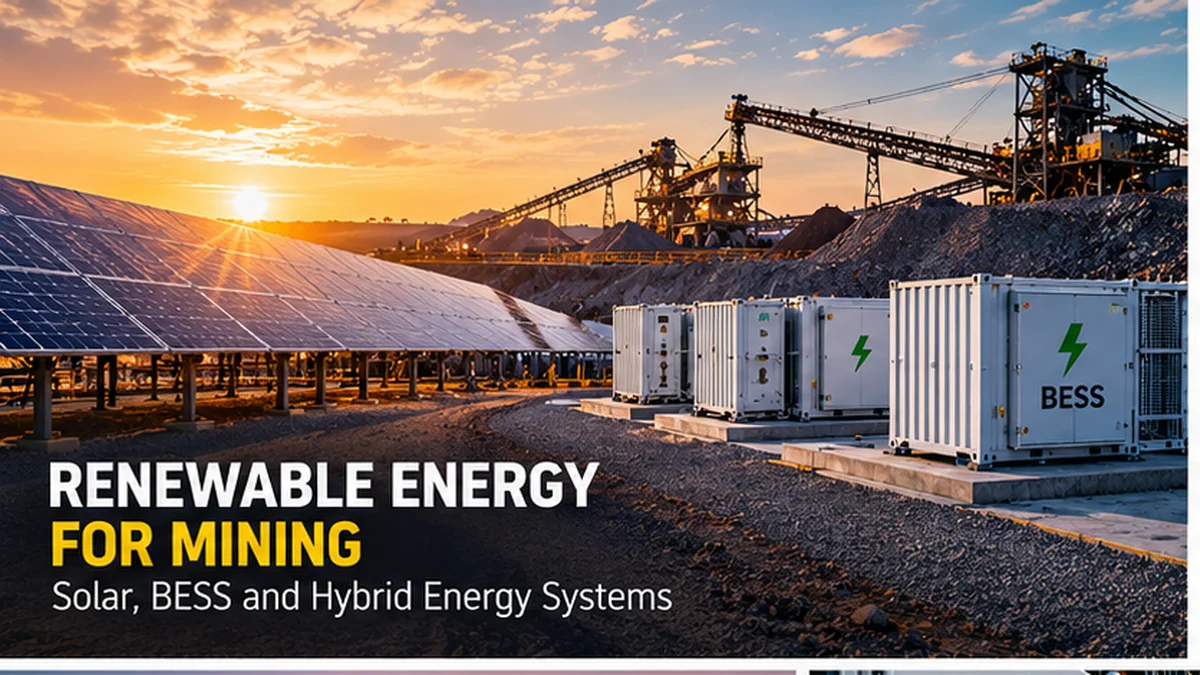
Mining operations need power strategies built around real load profiles, operating hours and site constraints. Solar, battery energy storage systems (BESS) and hybrid configurations can contribute, but each component serves a different purpose.
Why renewable energy for mining needs a site-specific approach
Mining loads can be continuous, seasonal or process-driven. Pumps, ventilation, conveyors, workshops and accommodation have different duty cycles. A useful feasibility assessment starts with interval demand data, peak demand, supply reliability and operational risk.
A renewable energy proposal should also consider site access, available land or roof area, dust, temperature, security and maintenance capability.
Where solar PV fits into a mine energy strategy
Solar PV generates electricity during daylight hours and can reduce grid or generator energy consumption when production aligns with sunshine. Generation varies with weather and the time of day, so solar should not be presented as guaranteed firm capacity.
For mining projects, designers should evaluate available space, electrical connection points, shading, equipment exposure and the effect of solar output on the existing supply system.
What battery energy storage systems (BESS) actually do
BESS can store energy for later use, help manage short-duration demand peaks and support selected loads during supply interruptions when appropriately engineered. Battery power rating (kW or MW) and usable energy capacity (kWh or MWh) answer different questions.
Storage duration, charge and discharge limits, round-trip losses, fire safety, protection coordination and replacement planning must all be assessed before specifying a system.
Hybrid systems: coordinating solar, storage and generators
A hybrid architecture may combine solar PV, BESS, grid supply and diesel generation under an energy management system. The controls determine when sources are dispatched, when batteries charge and which loads receive priority.
Hybrid operation needs careful consideration of generator minimum loading, fault levels, islanding, synchronization and black-start requirements where applicable.
How to evaluate costs, resilience and project delivery
Compare scenarios using lifecycle cost rather than only installed price. Model expected generation, diesel or grid offset, operating expenses, battery degradation, maintenance, curtailment and realistic downtime assumptions.
Procurement teams should request a documented basis of design, equipment specifications, construction schedule, commissioning plan and ongoing monitoring arrangements.
Project and procurement checklist
- Site load profile and maximum demand
- Current grid and generator arrangements
- Target loads and required backup duration
- Available space and environmental conditions
- Safety, controls and grid-interconnection requirements
- Lifecycle cost and maintenance assumptions
Questions buyers often ask
Can solar and BESS power an entire mine?
Possibly for some sites or periods, but feasibility depends on load, solar resource, storage duration and backup arrangements. Critical processes require a site-specific engineering study.
Is BESS the same as a generator?
No. A battery stores a finite amount of energy and requires a charging source; a generator produces electricity from fuel.
What should a mining operator share for an assessment?
Share interval consumption data, a single-line diagram where available, generator details, operational priorities, site constraints and desired resilience outcomes.
Discuss your requirement with Futuristic 1
For a project-specific discussion, send your scope, drawings, equipment schedule or bill of quantities. Technical selection and commercial proposals should be confirmed against the actual site and project requirements.