
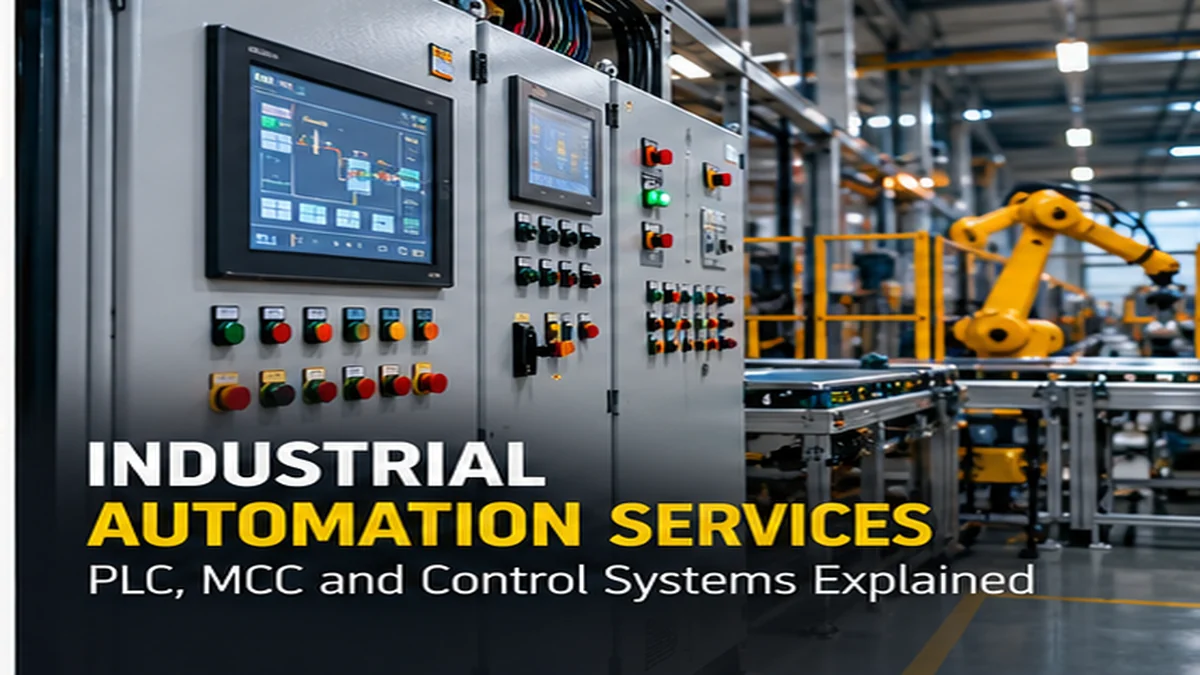
Industrial automation services connect sensors, controllers, motor starters and operator interfaces so industrial equipment can operate consistently. PLCs, motor control centres (MCCs) and supervisory systems each have a distinct role.
What industrial automation services cover
Typical projects include control-system design, PLC programming, HMI configuration, panel integration, instrumentation, motor controls, troubleshooting and commissioning. The first step is to define the process objective and measurable acceptance criteria.
Upgrades should account for legacy equipment, existing drawings, available spare parts and the ability to recover operations if a change does not perform as expected.
PLC: the logic behind machine control
A programmable logic controller (PLC) reads inputs from instruments and switches, executes programmed logic and commands outputs such as valves, drives and contactors. PLC selection depends on I/O capacity, communications, environment, lifecycle and reliability requirements.
Good engineering includes documented sequences, alarms, interlocks, backup copies and a tested change-management process.
MCC: distributing and controlling motor power
A motor control centre (MCC) houses equipment used to supply, protect and control multiple motors. Depending on the design, it may include circuit protection, contactors, overload relays, variable-speed drives and monitoring.
The MCC electrical design and the PLC control strategy must be coordinated, but they are not interchangeable components.
HMI, SCADA and instrumentation
Human-machine interfaces (HMIs) help operators view status and issue commands. SCADA systems may supervise larger processes, collect data and support alarms and trends. Instruments provide the measurements that make control decisions possible.
System design should define which alarms matter, who can change setpoints and how critical control continues if a display or network is unavailable.
Upgrade planning, cybersecurity and commissioning
A responsible automation upgrade begins with a control philosophy, I/O list, drawings and risk review. Factory acceptance testing, staged cutover, backups and site acceptance testing reduce avoidable disruption.
Network segmentation, controlled remote access and user permissions matter where industrial controls connect to wider networks. Keep the final code, licenses and as-built documents accessible to the site owner.
Project and procurement checklist
- Process description and control objectives
- Existing PLC, MCC and HMI inventory
- I/O list and electrical drawings
- Required interfaces and network architecture
- Shutdown and testing plan
- Backups, training and documentation
Questions buyers often ask
What is the difference between a PLC and an MCC?
A PLC executes control logic, while an MCC supplies and protects motor power circuits. They often communicate as part of one system.
Can an existing PLC system be upgraded in stages?
Often yes, subject to compatibility, safety and process constraints. A staged migration plan should be validated before implementation.
What is needed to quote an automation project?
Share process descriptions, current drawings, controller models, I/O requirements, operational constraints and desired functionality.
Discuss your requirement with Futuristic 1
For a project-specific discussion, send your scope, drawings, equipment schedule or bill of quantities. Technical selection and commercial proposals should be confirmed against the actual site and project requirements.